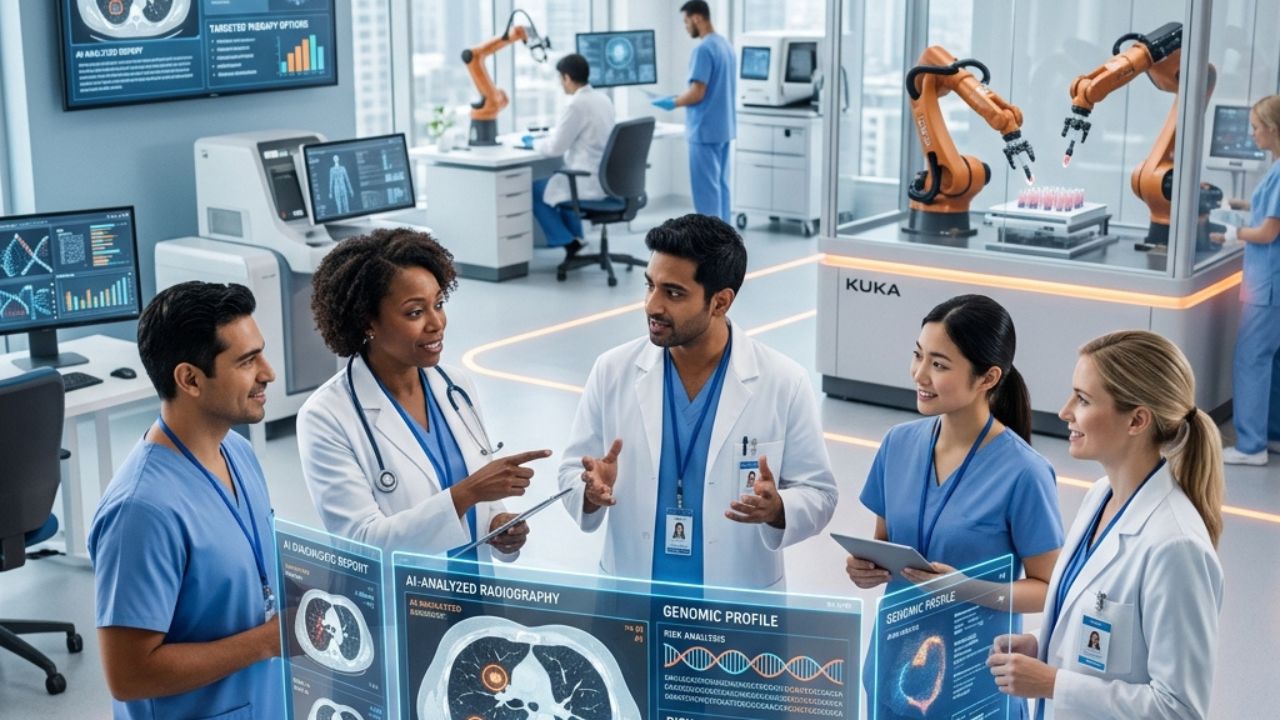
AI is transforming cancer detection by analyzing medical images, blood samples, and genetic data faster and often more accurately than traditional methods alone. It helps doctors catch cancer earlier, reduce diagnostic errors, and tailor screening to individual risk—though challenges around privacy, regulation, and integration remain.
Cancer remains one of the leading causes of death worldwide, claiming nearly 10 million lives each year according to the World Health Organization. For decades, the message from oncologists has stayed remarkably consistent: the earlier you catch it, the better your chances. A tumor spotted at stage one is often treatable. The same tumor found at stage four can be devastating.
The problem? Detection has always relied heavily on human eyes, human judgment, and a healthcare system stretched thin. Radiologists review thousands of scans. Pathologists examine tissue under microscopes. Mistakes happen, subtle warning signs slip through, and patients wait anxiously for results.
This is where artificial intelligence is changing the game. AI systems can now scan medical images, sift through genetic data, and flag suspicious patterns that humans might overlook—all at remarkable speed. In this post, we’ll explore how AI is reshaping cancer detection, from early screening to relapse prediction, and what hurdles still stand in the way.
How does AI improve early cancer detection?
Early detection is where AI shows some of its greatest promise. The technology excels at spotting patterns in vast amounts of data—exactly the kind of work that screening and diagnosis demand. By assisting doctors during the earliest stages, AI helps catch cancers when they’re most treatable.
How does AI analyze medical images in radiology, pathology, and dermatology?
Medical imaging is the foundation of cancer screening, and it’s where AI has made the biggest splash.
In radiology, AI models trained on millions of mammograms, CT scans, and MRIs can detect tumors and abnormalities with impressive consistency. These tools don’t get tired or distracted after a long shift. They highlight areas of concern for radiologists to review, acting as a tireless second set of eyes.
In pathology, AI helps analyze tissue samples at the cellular level. Examining biopsy slides is painstaking work, and an AI system can quickly scan a slide, identify cancerous cells, and even grade how aggressive a tumor appears. This speeds up diagnosis and brings more consistency to a process that can vary between specialists.
In dermatology, AI-powered apps and tools assess skin lesions and moles to flag possible melanomas. Some systems now match or exceed dermatologists in identifying suspicious spots from photographs, opening the door to earlier checks—even from a smartphone.
How does AI help discover cancer biomarkers in blood and genetic data?
Beyond images, AI is unlocking insights hidden in our biology.
Liquid biopsies—blood tests that look for fragments of tumor DNA—generate enormous amounts of data. AI algorithms can analyze these samples to detect traces of cancer long before symptoms appear, sometimes catching multiple cancer types from a single draw.
Genomic profiling is another frontier. Every tumor has a genetic fingerprint. AI tools comb through genetic sequences to identify mutations that signal cancer risk or reveal which treatments are most likely to work. This blends detection with the early stages of personalized care.
How does AI make cancer diagnosis more accurate?
Speed means little without accuracy. One of AI’s most valuable contributions is improving diagnostic certainty—reducing the errors that can delay treatment or cause unnecessary anxiety.
Can AI reduce false positives and false negatives?
False positives lead to needless biopsies, stress, and cost. False negatives are far more dangerous, allowing cancer to grow undetected. Both undermine trust in screening.
AI helps narrow these gaps. In breast cancer screening, studies have shown that AI-assisted readings can reduce false positives while catching cancers that human readers missed. A notable example comes from a 2020 study published in Nature, where a Google Health AI model reduced false positives and false negatives in mammogram analysis compared to radiologists alone. When AI and clinicians work together, the results often beat either working in isolation.
How does AI personalize cancer screening to individual risk?
Not everyone faces the same cancer risk, yet screening guidelines often treat broad age groups the same way. AI changes this by weighing individual factors—family history, genetics, lifestyle, and prior results—to estimate a person’s specific risk.
This means a high-risk patient might be flagged for earlier or more frequent screening, while a low-risk patient avoids unnecessary tests. Tailoring detection to the individual makes screening smarter and more efficient.
What are real-world examples of AI in cancer detection?
AI in oncology isn’t just theory. It’s already at work in hospitals, labs, and research centers around the world.
How is AI used in clinical trials and research?
Research institutions are running large-scale trials to validate AI tools across cancer types. Liquid biopsy companies like GRAIL have developed multi-cancer early detection tests, such as the Galleri test, designed to screen for many cancers from a single blood sample using machine learning. These efforts are generating the evidence needed to bring AI tools into everyday care.
Which AI cancer detection tools are in use today?
Several AI tools have earned regulatory clearance and entered clinical practice. Systems for analyzing mammograms, detecting lung nodules in CT scans, and identifying polyps during colonoscopies are now used in healthcare settings worldwide. The U.S. Food and Drug Administration has cleared a growing number of AI-based medical imaging devices, signaling that these tools are moving from experiment to standard practice.
What are the challenges of using AI in cancer detection?
For all its promise, AI in cancer detection comes with real obstacles. Rolling out these tools responsibly requires careful attention to ethics, regulation, and practical integration.
What are the data privacy and ethical concerns?
AI models learn from massive amounts of patient data, raising serious privacy questions. Who owns this data? How is it protected? There’s also the risk of bias: if an AI is trained mostly on data from one population, it may perform poorly for others. An algorithm that works well for one demographic but misses cancers in another could deepen existing health inequalities.
What regulatory and validation hurdles does AI face?
Medical tools must prove they’re safe and effective before reaching patients. AI systems face rigorous validation and approval processes, and rightly so. Regulators must confirm that a tool performs reliably across diverse patients and real-world conditions—not just in the controlled setting where it was built.
How does AI integrate with existing healthcare systems?
Even a brilliant AI tool is useless if it doesn’t fit into a clinic’s workflow. Many hospitals run on aging IT systems that don’t easily connect with new technology. Training staff, updating software, and earning the trust of busy clinicians all take time and money. Integration is often the quiet barrier that slows adoption.
What does the future of AI in cancer detection look like?
The current applications are just the beginning. As the technology matures, AI’s role in cancer detection will likely grow far more sophisticated.
How will predictive analytics identify at-risk populations?
Future AI systems will move beyond detecting existing cancer toward predicting who’s most likely to develop it. By analyzing health records, genetics, and environmental data across populations, AI could identify at-risk groups and guide prevention efforts before cancer ever takes hold.
Can AI monitor patients and predict cancer relapse?
Detection doesn’t end with a diagnosis. For cancer survivors, the fear of relapse looms large. AI-powered continuous monitoring—through wearables, regular blood tests, and routine scans—could catch a recurrence at its earliest, most treatable stage. This shifts care from reactive to proactive.
How will AI combine with other emerging technologies?
AI won’t work alone. Paired with advances in genomics, robotics, and nanotechnology, it could power entirely new approaches to detection and treatment. Imagine AI guiding a precision diagnostic device or interpreting data from a tiny sensor inside the body. The combinations are still unfolding.
The road ahead in the fight against cancer
AI is not replacing doctors. It’s becoming one of their most powerful allies. By spotting cancers earlier, cutting down on errors, and tailoring detection to each patient, AI is helping shift the odds in favor of patients—one scan, one blood test, one diagnosis at a time.
The challenges are real. Privacy, bias, regulation, and integration all demand thoughtful solutions. But the trajectory is clear. As these tools improve and earn the trust of clinicians and patients alike, AI stands to become a permanent fixture in the fight against cancer.
If you’re a healthcare professional, now is the time to learn how these tools work and where they fit into your practice. If you’re a patient or caregiver, ask your doctor about the screening technologies available to you. The earlier cancer is caught, the better the outcome—and AI is making “early” earlier than ever.
Frequently asked questions
Is AI better than doctors at detecting cancer?
AI isn’t necessarily better than doctors—it’s better used alongside them. Studies show that AI combined with clinician expertise often produces more accurate results than either working alone. AI excels at processing large volumes of data quickly, while doctors bring clinical judgment and context that machines lack.
How accurate is AI at detecting cancer?
Accuracy varies by cancer type and tool, but results are promising. In breast cancer screening, for example, a 2020 Nature study found that a Google Health AI model reduced both false positives and false negatives in mammogram analysis. Accuracy continues to improve as models train on larger, more diverse datasets.
Can AI detect cancer early?
Yes, early detection is one of AI’s biggest strengths. By analyzing medical images, blood-based liquid biopsies, and genetic data, AI can flag signs of cancer before symptoms appear—sometimes detecting multiple cancer types from a single blood sample.
What are the risks of using AI in cancer detection?
The main risks include data privacy concerns, algorithmic bias, and over-reliance on technology. If an AI is trained on limited data, it may perform poorly for underrepresented groups. That’s why human oversight, rigorous validation, and diverse training data remain essential.
Is AI cancer detection available to patients now?
Some AI tools are already in clinical use, including systems for analyzing mammograms, lung CT scans, and colonoscopies. Multi-cancer blood tests like the Galleri test are also available in certain settings. Availability depends on your location and healthcare provider, so ask your doctor what’s offered in your area.