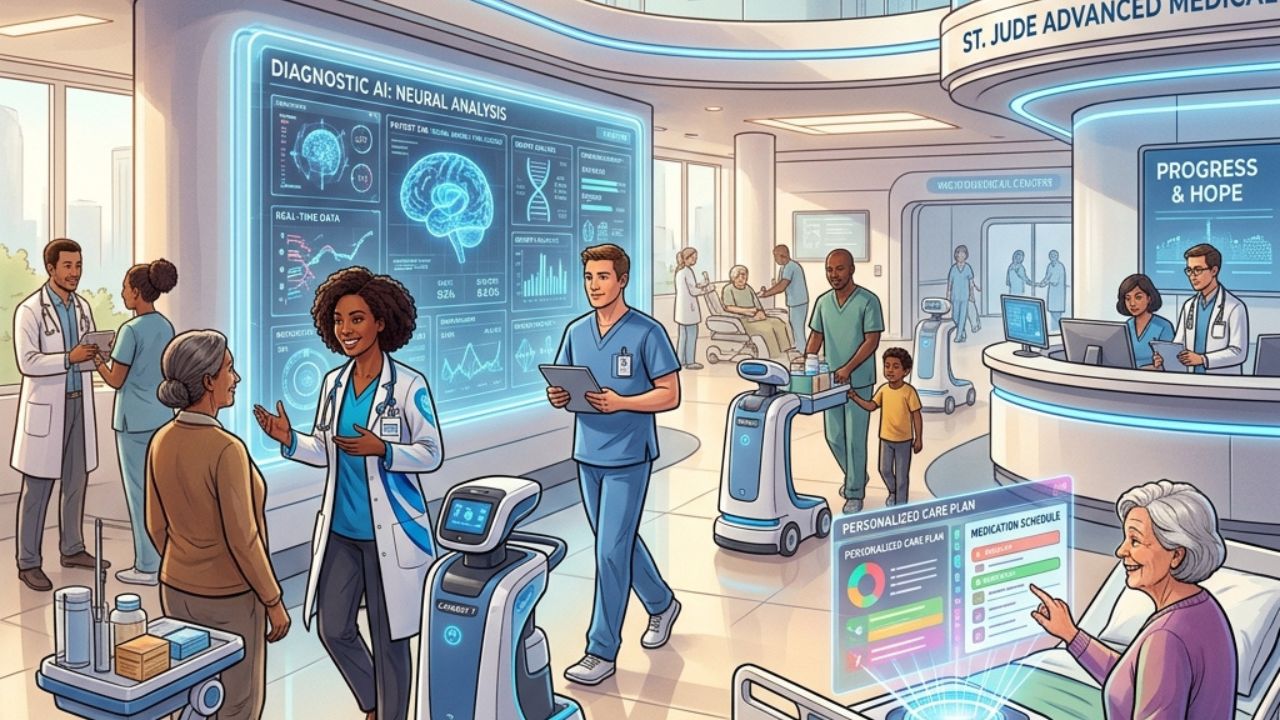
The American healthcare system currently faces a complex web of overlapping pressures. Medical professionals are dealing with unprecedented levels of burnout, administrative costs continue to climb, and patients frequently experience long wait times for critical care. Finding a sustainable path forward requires new tools and approaches.
Artificial intelligence offers a practical path forward. At its core, AI involves computer systems designed to perform tasks that typically require human intelligence. This includes recognizing patterns in data, making informed decisions, and understanding natural language. When applied to medicine, these capabilities align perfectly with the needs of modern clinics and hospitals.
Rather than replacing doctors or nurses, this technology acts as a powerful support system. It helps medical staff process vast amounts of data quickly, allowing them to focus more on direct patient care. By addressing both clinical and operational bottlenecks, AI holds the transformative potential to reshape the American healthcare landscape for the better.
AI Applications in Diagnosis and Treatment
The most direct impact of artificial intelligence in medicine happens right at the point of care. Algorithms are proving to be incredibly effective at supporting doctors as they diagnose and treat patients.
Enhancing diagnostic accuracy
Medical imaging has seen some of the most dramatic improvements thanks to machine learning. In fields like radiology and pathology, professionals must review hundreds of complex images daily. AI tools can rapidly analyze X-rays, MRIs, and CT scans to highlight areas of concern. These systems are trained on millions of previous scans, enabling them to spot microscopic anomalies that a human eye might miss. As a result, diseases like breast cancer and pneumonia are being detected much earlier, significantly improving survival rates.
Personalized treatment plans and precision medicine
Every patient responds differently to medical treatment. AI is making precision medicine a widespread reality by analyzing a patient’s genetic makeup, lifestyle, and medical history. Instead of relying on a generalized approach, doctors can use predictive models to determine which specific therapy will work best for an individual. This tailored approach reduces adverse reactions to medications and increases the overall effectiveness of treatments, particularly in complex fields like oncology.
Drug discovery and development acceleration
Bringing a new medication to market traditionally takes over a decade and costs billions of dollars. AI is drastically shortening this timeline. Researchers use advanced neural networks to simulate how different chemical compounds will interact with specific viruses or bacteria. By predicting the success of molecular structures early in the research phase, pharmaceutical companies can bypass years of trial and error. This accelerated drug discovery process means life-saving medications can reach American patients much faster.
AI in Operational Efficiency and Patient Management
Beyond the examination room, hospitals function as massive businesses with complex logistics. AI is proving just as valuable in the back office as it is in the laboratory.
Automating administrative tasks and reducing burnout
Paperwork and data entry are major drivers of physician burnout. Doctors often spend hours updating electronic health records (EHR) after their shifts end. Natural language processing tools can now listen to patient consultations and automatically draft clinical notes. Furthermore, algorithms can streamline medical coding and billing processes. By removing these administrative burdens, medical professionals regain valuable time to spend with their patients and their families.
Predictive analytics for patient outcomes and hospital management
Hospitals generate massive amounts of data every single day. Predictive analytics tools sift through this information to forecast everything from patient admission rates to the likelihood of hospital readmissions. If an AI system flags a patient as having a high risk of readmission for heart failure, the care team can intervene before the patient goes home. On a facility level, these predictions help hospital administrators optimize staffing schedules and manage medical supply inventories efficiently.
Improving patient engagement and remote care
The rise of telehealth has been supercharged by AI integrations. Virtual nursing assistants and smart chatbots can answer basic patient questions 24/7, triage symptoms, and schedule appointments. Wearable devices equipped with machine learning algorithms track vital signs like heart rate and blood oxygen levels in real time. If a patient’s metrics drop into a dangerous range while they are resting at home, the system can automatically alert their care team. This proactive approach keeps patients engaged in their own health and reduces unnecessary hospital visits.
Challenges and Ethical Considerations
While the benefits are substantial, integrating advanced technology into a highly regulated industry brings several notable challenges.
Data privacy and security concerns
Training artificial intelligence requires enormous datasets. In healthcare, this means handling deeply sensitive personal information. Hospitals and tech companies must navigate strict HIPAA regulations to ensure patient data remains anonymous and secure. As cyberattacks on medical facilities become more frequent, protecting the infrastructure that houses these AI systems is a critical priority.
Regulatory hurdles and implementation challenges
The Food and Drug Administration (FDA) is actively working to regulate software as a medical device. However, the approval process for AI algorithms remains complex because machine learning models constantly evolve as they process new data. Furthermore, integrating new AI software into older, fragmented hospital IT systems requires significant time and financial investment from healthcare providers.
Bias in AI algorithms and equitable access
An AI model is only as good as the data used to train it. If a diagnostic algorithm is trained primarily on data from specific demographic groups, it may misdiagnose patients from underrepresented populations. Developers and medical boards must actively audit their systems to eliminate algorithmic bias. Ensuring that rural and underfunded clinics have access to these advanced tools is also necessary to prevent the healthcare gap from widening.
The Future of AI in American Healthcare
The groundwork has been laid, and the next decade will likely see artificial intelligence become an invisible, ubiquitous part of medical care.
Emerging trends and technologies
Generative AI is poised to take on even more complex tasks, such as generating customized patient discharge summaries and translating complex medical jargon into plain language for families. Robotic surgery, guided by real-time AI spatial analysis, will become more precise and less invasive. We will also see greater integration of ambient clinical intelligence, where the hospital room itself monitors the patient passively.
Policy recommendations for AI integration
To safely scale these technologies, policymakers need to establish clear frameworks for accountability. If an AI makes an incorrect recommendation, liability must be clearly defined. Continuous monitoring of deployed AI systems should be mandated to ensure they remain accurate over time. Government incentives could also help smaller clinics afford these digital upgrades.
Long-term impact on healthcare providers and patients
The narrative that AI will replace doctors is fundamentally flawed. Instead, the future points toward a collaborative relationship. Medical professionals who leverage AI will consistently outperform those who do not. Patients can look forward to a system that is more responsive, highly personalized, and significantly more accurate.
Embracing a Healthier Future
Artificial intelligence is not a distant concept; it is an active force modernizing American healthcare. By improving diagnostic accuracy, accelerating drug discovery, and streamlining hospital operations, this technology is solving some of the industry’s most stubborn problems.
Challenges regarding data privacy, algorithmic bias, and regulation must be carefully managed. However, the potential to save lives and reduce provider burnout makes the effort worthwhile. As we look ahead, the goal is not to hand medicine over to machines. The goal is to use these advanced systems to remove friction and inefficiencies, allowing doctors and nurses to focus on the human empathy and care that medicine will always require.