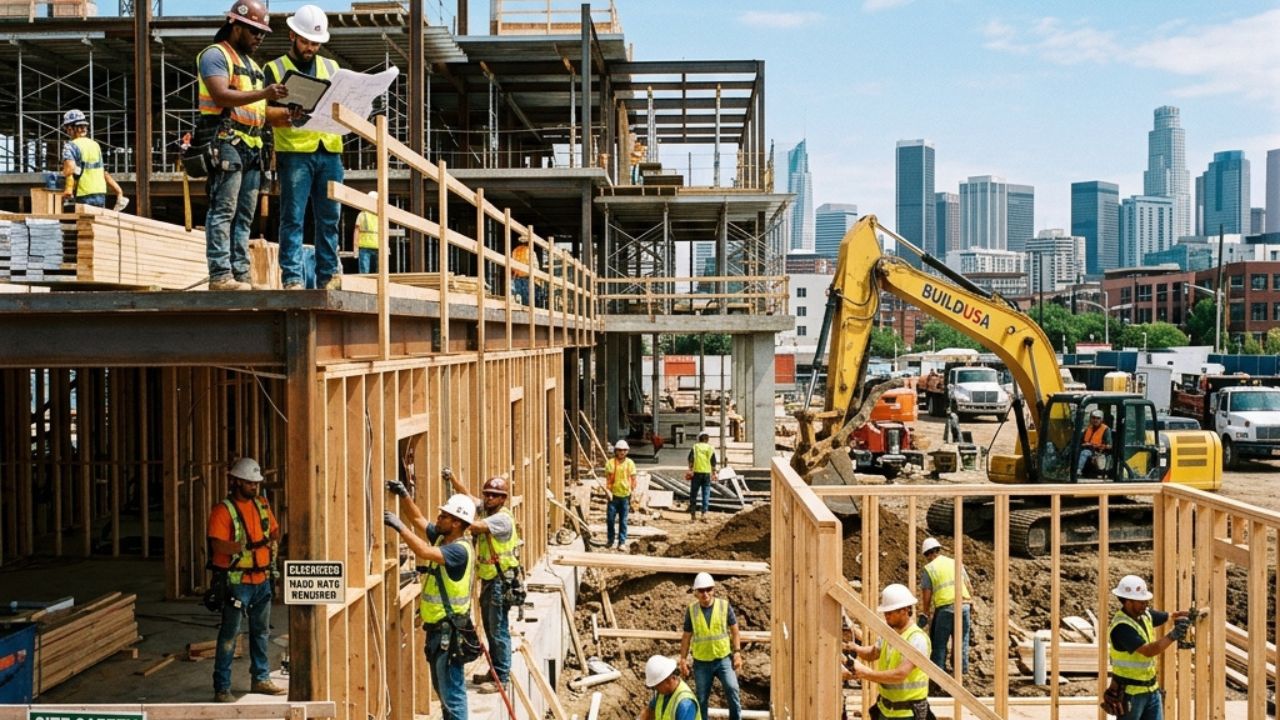
The skyline of every major city, the roads connecting our towns, and the homes we live in all share one common origin. They are the result of hard work, precise planning, and the dedicated effort of construction workers. As the backbone of infrastructure and real estate development, the construction industry represents a massive segment of the United States economy.
Choosing a career in this field means entering an industry with diverse opportunities, tangible results, and a strong sense of community. You get to see the physical proof of your labor at the end of each day. From building residential neighborhoods to erecting massive commercial skyscrapers, construction worker jobs in the USA offer pathways for people of all educational backgrounds and skill levels.
This guide explores everything you need to know about navigating a career in construction. We will cover the types of roles available, the current job market demand, necessary skills, salary expectations, and how to land your ideal position. Read on to discover how you can build a rewarding career in one of America’s most essential industries.
Types of Construction Jobs
The construction industry is incredibly varied. It requires a massive team of specialists and generalists working together to bring a project from a blueprint to a finished structure.
Skilled Trades
Skilled tradespeople are the specialists of the construction site. They possess highly specific knowledge and usually require formal apprenticeships or certifications. Electricians ensure buildings have safe and functional power systems. Plumbers install and repair piping for water and gas distribution. Carpenters focus on the structural framework, working with wood and other materials to build the skeleton of a building, install cabinetry, and finish trims. These roles are highly respected and consistently in demand.
Laborers and Operators
General laborers are the engine that keeps a construction site moving. They handle site preparation, load and unload materials, assist tradespeople, and maintain site safety. Meanwhile, heavy equipment operators drive the massive machinery required for large-scale projects. They control bulldozers, excavators, cranes, and forklifts to move earth, hoist heavy steel beams, and clear debris.
Supervisory Roles
Every successful project requires strong leadership. Foremen and construction managers oversee daily operations, ensuring that the team works efficiently and safely. They coordinate schedules, manage budgets, and act as the bridge between the boots on the ground and the project stakeholders. Becoming a supervisor usually requires years of hands-on experience and a deep understanding of the entire construction process.
Demand and Outlook for Construction Jobs
The United States is experiencing a continuous need for infrastructure renewal and new housing developments. This creates a highly favorable environment for job seekers in the construction sector.
Current Job Market Trends
Recent federal investments in infrastructure have created a surge in demand for qualified construction workers. States are launching large-scale initiatives to repair bridges, expand highways, and upgrade public transit systems. At the same time, the residential sector continues to build new housing to accommodate a growing population. Many construction companies report a shortage of qualified workers, meaning that those with the right skills have a distinct advantage when applying for jobs.
Future Projections and Growth Areas
The Bureau of Labor Statistics anticipates steady growth for construction occupations over the next decade. Green construction is one of the most exciting areas of expansion. As the nation focuses on sustainability, there is an increasing need for workers skilled in installing solar panels, building energy-efficient homes, and using environmentally friendly materials.
Key Skills and Qualifications
Succeeding in USA construction worker jobs requires a blend of physical ability, technical knowledge, and interpersonal skills.
Essential Hard Skills
Hard skills vary depending on your specific role. A carpenter needs precise measurement and cutting skills, while an electrician must understand complex wiring diagrams. However, almost all construction workers need a basic understanding of building codes, blueprint reading, and tool operation. Physical stamina and strength are also crucial, as the job requires lifting heavy materials and standing for long periods.
Important Soft Skills
Technical abilities alone will not guarantee a successful career. Soft skills are equally important on a busy job site. Communication is vital for coordinating with team members and avoiding dangerous accidents. Problem-solving skills help workers adapt when materials run late or weather disrupts a schedule. Additionally, a strong work ethic and reliability are highly valued by construction managers.
Education and Training Pathways
You do not necessarily need a four-year college degree to thrive in construction. Many workers start as unskilled laborers and learn on the job. For skilled trades, apprenticeships are the most common pathway. These programs combine paid on-the-job training with classroom instruction. Community colleges and vocational schools also offer certificates and associate degrees in construction management, electrical technology, and plumbing.
Salary and Benefits in the Construction Sector
Financial stability is a major draw for the construction industry. Compensation packages often reflect the physical demands and technical expertise required by the work.
Average Wages by Role and Experience
Earnings in construction depend heavily on your specific trade, location, and experience level. Entry-level general laborers usually earn an hourly wage that sits comfortably above the national minimum wage. As workers gain experience and move into skilled trades like plumbing or electrical work, their earning potential increases significantly. Experienced equipment operators and construction managers often command lucrative salaries, sometimes exceeding six figures annually.
Benefits and Compensation Packages
Beyond base pay, many construction jobs offer robust benefit packages. Unionized workers often receive comprehensive health insurance, pension plans, and paid time off. Even non-union companies frequently provide retirement matching, performance bonuses, and continuous training allowances to retain their best talent.
Challenges and Opportunities
Like any profession, working in construction comes with its own set of hurdles and exciting developments.
Workplace Safety and Regulations
Safety is the top priority on any job site. Construction workers face hazards like working at heights, operating heavy machinery, and handling hazardous materials. Employers are required to adhere to strict Occupational Safety and Health Administration (OSHA) standards. Workers must wear appropriate personal protective equipment (PPE) and attend regular safety briefings to minimize the risk of injury.
Technological Advancements in Construction
The image of construction relying solely on manual labor is rapidly changing. Technology is transforming how buildings are designed and assembled. Drones are used for site surveying and progress tracking. Building Information Modeling (BIM) software allows teams to create detailed 3D models of structures before breaking ground. Workers who adapt to these new technologies will find themselves highly sought after by modern construction firms.
Promoting Diversity and Inclusion
Historically, construction has been a male-dominated field. However, the industry is actively working to change this. Many organizations and companies are launching initiatives to recruit women and minorities into the trades. This push for diversity brings new perspectives to job sites and helps alleviate the ongoing labor shortage.
How to Find and Secure a Construction Job
Landing a job in the construction industry requires a proactive approach and a clear understanding of what employers are looking for.
Job Search Strategies
Start by looking at industry-specific job boards and local classifieds. Many construction companies also post openings directly on their websites. If you are interested in a skilled trade, contacting local union chapters can be an excellent way to find apprenticeship openings. Staffing agencies that specialize in industrial and construction labor can also connect you with temporary jobs that often lead to permanent employment.
Resume and Interview Tips
Your resume should clearly list any relevant experience, certifications, and specific tools or machinery you know how to operate. If you are new to the field, highlight transferable skills like physical stamina, teamwork, and a willingness to learn. During the interview, emphasize your commitment to safety and reliability. Employers want to know that you will show up on time, follow instructions carefully, and work hard.
Networking in the Industry
Building relationships can open doors that standard applications cannot. Attend local trade shows, job fairs, and industry networking events. Connect with construction professionals on platforms like LinkedIn. Sometimes, simply visiting a job site and speaking respectfully with the foreman can lead to an entry-level opportunity.
Laying the Foundation for Your Career
The construction industry offers a unique blend of physical engagement, strong earning potential, and the pride of building something that lasts. Whether you choose the path of a specialized electrician, a skilled heavy equipment operator, or a project manager, USA construction worker jobs provide a stable and rewarding career trajectory.
Take the time to evaluate which type of role aligns with your interests and strengths. Look into local apprenticeship programs, update your resume to highlight relevant skills, and start connecting with local construction firms. The nation is always building, and there is a place on the site for those ready to put in the work.